
Our Projects
Biosand Water Filters and pastoral ministry across Baja California, Mexico.
Bringing Clean Water to Baja California
Baja Clean Water Mission constructs and installs concrete Biosand Filters in households across Baja California. Each filter is built to established engineering standards, tested before delivery, and installed with hands-on household training.
Filtration Science
Our filters use natural biological and physical processes to reduce waterborne pathogens — no electricity or chemicals required.
Up to 100%
Helminth Removal
Parasitic worm eggs and larvae are too large to pass through the fine sand bed. Documented performance varies by operating conditions and source water.
Up to 98.5%
Bacterial Reduction
Laboratory results; field performance 87.9%–98.5%. Results vary with construction, maintenance, source water, and operating conditions.
~95%
Turbidity Reduction
Documented laboratory and field performance. Results vary with construction, maintenance, source water, and operating conditions.
Quality Control
Every filter is manufactured and installed according to rigorous engineering guidelines. Quality control is enforced at every stage of construction and installation.
Concrete Casting & 7-Day Curing
Filters are cast using heavy-duty steel molds and undergo a full 7-day wet-curing process to achieve full tensile strength before delivery.
Precision Sand & Gravel Sifting
Raw materials are mechanically screened through standardized sieves. All filtration sand must pass through the 0.7 mm sieve; gravel layers are washed free of organic matter and fine clay.
Pre-Installation Flow Rate Testing
Before delivery, filters are filled to the 12-liter capacity mark and flow rates are measured. Flow must test at or below 400 mL/min.
Standing Water & Siphon Calibration
During home installation, technicians level the sand bed and verify that standing water depth rests exactly 5 cm above the sand bed when flow stops.
How We Work
Biosand Filter Construction
We build concrete Version 10 Biosand Filters using CAWST-developed engineering standards.
Each filter is cast, cured, sifted, flow-tested, and calibrated before installation.
Household Installation & Training
Our team installs each filter in the home and provides hands-on training on operation, maintenance, and hygiene.
Families learn the Swirl and Dump cleaning method and proper outlet hygiene.
Pastoral Ministry & Follow-Up
Installation visits open the door to ongoing relationship, prayer, and pastoral care with each household.
We work alongside local Mexican pastors and church leaders for long-term community presence.
From Filter to Household
We serve families and households in communities across Baja California, Mexico, beginning where we have an opportunity to build trusted local relationships.
Build & Quality-Check
Each concrete Biosand Filter is constructed, cured, and tested before it leaves our hands. Filters that do not meet flow-rate and calibration standards are corrected before delivery.
Transport to the Community
Completed filters are transported to the communities in Baja California where we are actively serving. Delivery is coordinated around household visits rather than drop-offs.
Household Delivery & Training
During a household visit, the filter is placed in the home and the family is shown how to operate, clean, and care for it. The goal is that every household leaves the visit confident in how to use their filter.
Relationship, Not Just Equipment
The installation visit is also an opportunity to meet the family, listen to what they need, and begin an ongoing relationship. We are not delivering a product — we are beginning a connection.
Follow-Up & Ongoing Care
Where possible, we return to check on the filter and continue the relationship. For some households, that ongoing connection includes prayer, encouragement, and — where appropriate — relationships with local churches and pastors.
The Science of Biosand Filtration
Baja Clean Water Mission uses concrete Biosand Filters to help transform contaminated water into safer drinking water for households across Baja California. These filters use natural biological and physical processes rather than electricity or complex chemical treatment.
How a Biosand Filter Works
Mechanical Trapping
Fine filtration sand with grain sizes under 0.7 mm physically traps suspended solids, silt, and larger organisms — including parasite eggs and helminths — in the narrow pore spaces between sand grains.
Predation — The Biolayer
In the upper portion of the sand bed, an active biological layer called the biolayer (or schmutzdecke) develops. Microorganisms living in this layer consume incoming bacteria, protozoa, and other organic pathogens.
Adsorption
As water flows through the sand bed, pathogens adhere to the surface of sand grains and to each other through natural electrostatic attraction, removing them from the water column.
Natural Die-Off
Deeper in the sand bed, pathogens that escape predation starve or die due to the absence of light, oxygen, and nutrients. This zone provides a final passive treatment barrier.
Documented Treatment Performance
The following figures represent documented laboratory and field performance from published research. Performance varies with filter construction, maintenance, source water quality, and operating conditions. These are not guarantees for every installation.
| Pathogen / Contaminant | Documented Removal Rate |
|---|---|
| Helminths (Parasitic Worms) | Up to 100% |
| Protozoa (Giardia & Cryptosporidium) | >99.9% |
| Bacteria (E. coli & Fecal Coliforms) | Up to 98.5% |
| Viruses | 70%–>99% |
| Turbidity & Iron | ~95% |
The Biological Layer
The biological layer develops in the upper 1–2 cm of the sand bed and plays a central role in pathogen removal. It begins forming when the filter is first used and reaches full treatment efficiency over approximately 30 days of daily use. During this initial maturation period, secondary disinfection — such as boiling, SODIS, or chlorination of filtered water — is recommended. The biolayer requires regular daily use and proper operating conditions to remain active. If the filter sits unused for extended periods or the sand dries out, the biological layer may be disrupted and will need time to recover.
Quality Control & Technical Standards
Baja Clean Water Mission follows established Biosand Filter construction and operating principles. Quality control is important at every stage — from raw material preparation through final installation in the home.
Inside the Biosand Filter
Each concrete Version 10 Biosand Filter contains precisely layered materials that work together to provide structural stability and filtration performance.
Diffuser Plate
A galvanized sheet metal plate with 3 mm holes sits at the top of the filter. It protects the sand surface from erosion when water is poured in, preventing disturbance to the biolayer.
Standing Water Layer
Maintained at exactly 5 cm (4–6 cm range) above the sand bed by the elevated outlet siphon pipe. This depth keeps the biolayer moist and oxygenated during pause periods.
Fine Filtration Sand
Standardized sand with grain sizes under 0.7 mm provides the primary biological and mechanical filtration zone where the biolayer develops.
Separation Gravel
An intermediate gravel layer (0.7–6 mm) prevents fine sand from migrating downward and blocking the outlet pipe.
Drainage Gravel
Coarse gravel (6–12 mm) at the base surrounds the outlet tube opening, ensuring smooth water drainage without clogging.
Our Quality Control Process
Every filter produced by Baja Clean Water Mission passes through four quality control checkpoints before it enters a household.
Step 1
Concrete Casting & Curing
Filters are cast using heavy-duty steel molds. After demolding, concrete bodies undergo a full 7-day wet-curing process — kept moist under plastic tarps or submerged — to achieve full tensile strength and prevent leaks or wall cracking.
Step 2
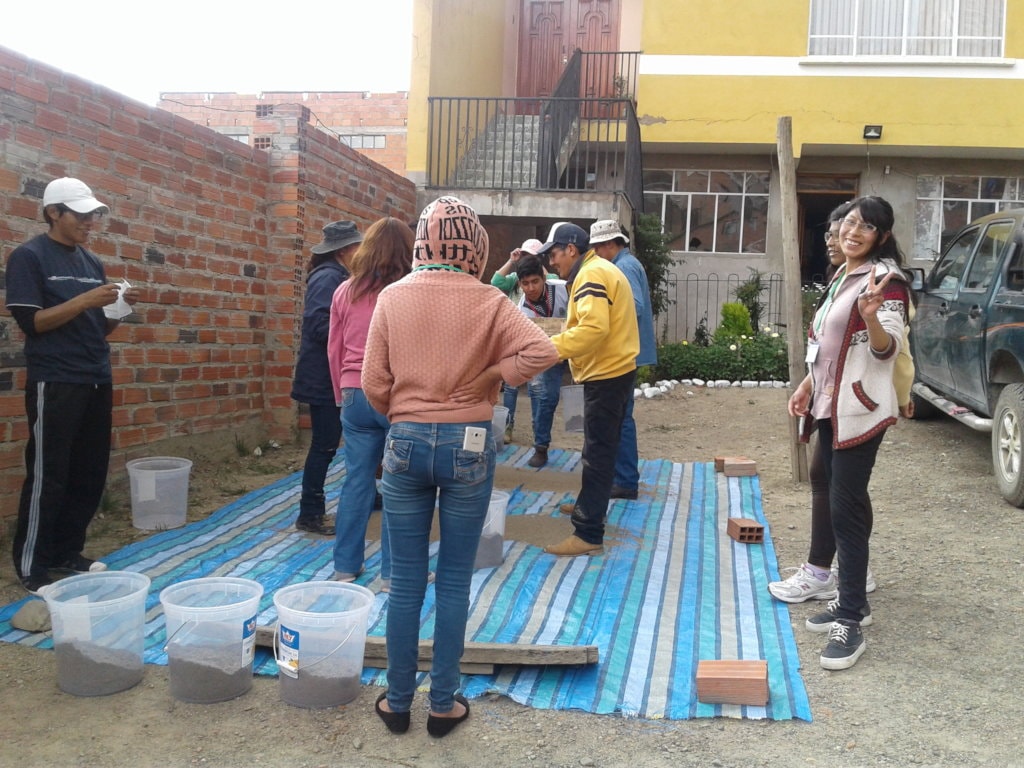
Sand & Gravel Sifting
Raw materials are mechanically screened through a standardized sieve set (12 mm, 6 mm, 1 mm, and 0.7 mm mesh). All filtration sand must pass through the 0.7 mm sieve. Separation and drainage gravel are washed completely free of organic matter and fine clay.
Step 3
Flow-Rate Testing
Before delivery, each filter is filled to the 12-liter capacity mark and the flow rate is measured. Flow must test at or below 400 mL per minute. A rate exceeding this limit indicates over-washed sand or incorrect media sizing and requires correction before installation.
Step 4
Standing-Water & Outlet Calibration
During home installation, technicians level the sand bed and verify that the standing water depth rests exactly 5 cm above the sand bed when flow stops. The outlet siphon height is adjusted as needed.
Household Care & Maintenance
Providing a filter is only the beginning. Every household receives instruction on proper operation, cleaning, sanitation, and ongoing care.
Restoring Flow — The Swirl and Dump Method
Over weeks of daily use, organic sediment accumulates in the top layer of sand and gradually slows the flow rate. When the flow becomes too slow for household convenience, families perform the Swirl and Dump cleaning method:
- 1Add water to the upper reservoir — approximately one gallon or a few inches.
- 2Remove the diffuser plate and set it aside.
- 3Gently swirl the upper layer of sand with your hand to loosen accumulated sediment.
- 4Remove the dirty water from the reservoir.
- 5Level the sand surface and replace the diffuser plate.
Note: Cleaning the upper sand temporarily disrupts the biological layer. After a Swirl and Dump cleaning, the filter requires time — typically several days of regular use — to recover its normal biological treatment performance. During this recovery period, secondary disinfection of filtered water is recommended.
Important Hygiene Practices
Proper hygiene around the filter outlet is essential to prevent recontamination of treated water.
- Keep the outlet spout clean and free of visible dirt or residue.
- Never allow hands, fingers, or dirty containers to contact the outlet spout.
- Clean the outlet according to the household training instructions provided at installation.
- Never pour chlorine or other disinfectants directly into the filter — this can damage or destroy the biological layer.
- If additional disinfection is needed, apply it to the filtered water after it has left the filter — not inside the filter itself.
Want the full technical explanation?
Our educational resource covers every aspect of Biosand Filter science, construction, and operation in depth.
Support Clean Water Ministry
Your gift helps fund filter construction, materials, installation, and ongoing pastoral ministry in Baja California.